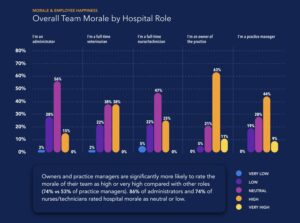
The last several years have brought continuous—at times dizzying—change to the veterinary industry, and 2023 was no different. Veterinary practices are feeling the heat more than ever, with staffing shortages, soaring patient volumes, and mental health concerns driving record lows for team morale and retention. Industry surveys have begun to paint a clearer picture of these issues and how veterinary practices are tackling them. However, data specific to the emergency and specialty sector has typically been limited. This summer, the Instinct Science team set out to better understand how hospitals in this vital sector are evolving amidst mounting challenges. We surveyed more than 250 emergency, specialty, and urgent care professionals to develop the inaugural report: “The State of Emergency and Specialty Veterinary Care in 2023.” Detailed below are what was uncovered in the research, from the nitty-gritty of team morale to the most effective approaches for keeping talent and growing in this ever-evolving field. Consider this your backstage pass to insights that will help you level up productivity, rethink hiring and team structure, and invest in technology to help navigate these turbulent times. The biggest challenges in emergency and specialty care In 2023, the landscape of emergency and specialty care is a tale of two challenges: the relentless surge in patient volumes and widespread staffing shortages.1 Surging patient volumes Patient volume is on a dramatic upswing across the industry, which has profoundly impacted emergency and specialty hospitals. In our survey, 54 percent of respondents reported higher patient volumes than in 2022. Even more striking, 59 percent pinpointed the escalation of patient volumes as a key challenge facing their hospital. As patient numbers rise, hospitals must grapple with heavier workloads and longer wait times for clients, leading to increased working hours and rising rates of burnout. These telling stats best illustrate the gravity of the situation in emergency and specialty hospitals: In 2023, 33 percent of hospitals witnessed a surge in working hours. Most respondents (50 percent) reported that their hospital’s average wait time eclipsed the one-hour mark. Stress and mental health challenges emerged as top issues, impacting a concerning 83 percent of survey participants. Staffing shortages Staffing shortages have reached a critical juncture in emergency and specialty hospitals, with 86 percent of respondents reporting difficulty hiring and retaining staff. Add the increase in patient volumes, and you have a perfect storm of busyness. The strain on existing staff members is palpable. More than 80 percent of respondents reported feeling stressed, overwhelmed, or burned out. The hospitals’ bottom line suffers too: 43 percent of respondents reported that missed charges were a frequent result of the overwhelming workload. How hospitals are already leveling up In the face of escalating challenges, innovation has emerged as the antidote of choice. More than ever, hospitals are embracing creative workflow enhancements, integrating new technology, and trying fresh approaches to staff training to withstand the mounting demands. Upgrading tech and workflow tools to enhance productivity The survey revealed that emergency and specialty hospitals have embraced or upgraded to digital treatment sheets (38 percent), transitioned to cloud-based PIMs/EMRs (36 percent), or adopted client communications platforms (32 percent) in the past year. Notably, urgent care and smaller emergency hospitals have been at the forefront of implementing workflow enhancements, technology integration, staff training, and pricing strategies. Further analysis uncovered a compelling correlation between staff retention and investments in new technology: Hospitals that reported no turnover in the past year were 30 percent more likely to have implemented digital treatment sheets. Similarly, hospitals with a high retention rate were 20 percent more likely to have implemented a cloud-based PIMs. Enhancing productivity stands as a top priority for veterinary hospitals in 2023. Respondents unequivocally identified team expansion, workflow refinements, and technology adoption (PIMs/EMR and treatment sheets) as the most impactful productivity improvements. Investing in the team: new hires and new ways to keep them In the face of rising demand and widespread shortages of veterinary talent, the employment landscape in emergency and specialty care has decidedly tilted in favor of employees. Veterinary professionals are increasingly switching roles, enticed by competitive salaries, relief work opportunities, and improved work-life balance. Survey responses confirmed that the biggest elephant in the room for job changes is burnout. About half of full-time veterinary technicians and nurses cite burnout/mental health challenges (51 percent) and work-life balance concerns (49 percent) as primary reasons for seeking a new role. Burnout, workplace culture/dynamics, work-life balance, and personal reasons drove the majority of staff turnover in emergency and specialty hospitals in 2023. While veterinary staff are increasingly switching jobs, we continue to witness a significant staff shortage across the industry. More than 80 percent of survey respondents referenced the lack of qualified candidates. Across all roles, technicians and nurses have emerged as the most sought-after hires in 2023. Emergency and specialty hospitals are vigorously recruiting technicians, veterinarians, and administrative staff at a rate five times higher than staff reductions. To stay competitive, specialty and small emergency organizations are increasing sign-on bonuses and other incentives. Of the 29 percent of respondents who took new jobs in the last 12 months, 41 percent were offered a sign-on incentive. Sign-on bonuses are most regularly offered to veterinarians compared to other staff positions.2 Across the industry, we have also seen a substantial uptick in wages over the past year, with 86 percent of practices raising salaries in the past year.3 Hospitals that can match or exceed industry standard wages likely have a better chance of improving job satisfaction and retaining staff. Increasing morale with technology, training, and mental health support Survey responses revealed a significant disconnect between management and staff regarding team morale. Owners (74 percent) and practice managers (53 percent) are significantly more likely to rate team morale as high or very high than other roles. Most administrators (86 percent) and 74 percent of nurses/technicians rated hospital morale as neutral or low. Among the practice types surveyed, urgent care staff stand out, with an impressive 80 percent reporting high or very high morale. Notably, urgent cares are leading the way in offering mental health and wellness days, while larger hospitals primarily offer Employee Assistance Programs (EAPs). Despite the prominence of these programs, EAP utilization rates remain incredibly low across industries; the National Business Group on Health found the median utilization of EAPs is roughly 5.5 percent.4 There is a burden of education put on staff before an EAP can be used. On the other hand, mental health or wellness days can be easily communicated and adopted, and they simply require organizations to encourage staff to take time off for their well-being. Of hospitals that did not experience staff turnover in the last 12 months, 11 percent more responded their company provided time off for mental health or wellness days. In other words, time off for mental health has the most positive impact on staff retention over any other wellness program. Here is what respondents rating morale “high” or “very high” had in common: Their hospital was more likely to conduct regular staff meetings, implement changes based on staff feedback, and offer training and support for specific concerns. Hospitals that invested in new technology over the past year experienced a commendable 10 percent surge in staff retention. There is a positive correlation between hours worked and higher morale—likely due to owners and veterinarians being the most likely to work 50+ hours a week. Job morale ratings peaked at three-five years of experience (46 percent reporting high team morale). Neutral morale is the highest in the first one-two years of employment experience. The biggest drivers of higher staff morale and retention were team expansion, mental health days/flexible schedules, and technology-oriented investments. Key takeaways for hospital leaders So, what is the bottom line here? Study says: Invest in staff early on, make the right hires and train them well, offer time off for mental health, listen to team members, and improve your tech stack. Invest in employees’ early years. The survey shows that neutral morale is most prevalent among staff with one to two years of experience. Start by ensuring your team members get top-notch onboarding and training programs and give them ways to share their thoughts and concerns directly with management. Addressing morale concerns early in your team members’ careers can improve their desire to stick around well beyond that initial period. Think of it as an investment that builds strong bonds and keeps people committed to your practice for the long haul. Make the right hires and invest in training. Take a moment to assess your current staffing levels and workload to identify areas where additional team members could make a meaningful impact. (See Recommendations for Attracting Top Veterinary Talent.) Seek out qualified candidates and consider expanding your team strategically to fill gaps in expertise or address specific needs. Prioritize team training and collaboration to ensure seamless integration of new hires into the existing workforce. Offer mental health and wellness days. Our survey results made it clear that time off for mental health or wellness days significantly impacts staff retention. Review your benefits package and consider incorporating specific mental health and wellness days. Encourage your team to use these days without hesitation to prioritize their mental well-being. Most importantly, promote a culture of open communication where employees feel comfortable discussing their mental health concerns and taking time off when they need it. Address morale during regular staff meetings. Hospitals with the highest reported morale were more likely to conduct regular staff meetings, implement changes based on staff input, and offer training and support to address specific concerns. Regular staff meetings create opportunities for open communication and feedback. Implement changes based on staff input and offer training and support to address specific concerns. Invest in technology-related improvements. Evaluate your current technological infrastructure and identify areas where digital upgrades could streamline processes. Invest in user-friendly practice management platforms, cloud-based PIMs/EMRs, and client communication tools to enhance workflow efficiency. Provide comprehensive training and ongoing support to ensure your team can fully harness the benefits of these technological advancements. Recommendations for attracting top veterinary talent In this extra-competitive hiring landscape, securing and keeping top talent is crucial. The obvious question: How? Focus on two key areas: innovation and staff well-being. Qualified veterinary candidates increasingly seek roles at hospitals that prioritize innovative technologies, mental health and wellness support, and team expansion. The following recommendations can help you build (and keep) a passionate, innovative, and well-supported team. Foster a culture of innovation. Celebrate and encourage innovation in your practice. Allocate dedicated time for experimentation, empowering staff to test new ideas and unconventional solutions. Embrace failure as a valuable learning opportunity and share stories of past failures that paved the way for success. Embrace technology. Technology is an enabler—not a disruptor. The seamless integration of digital tools such as practice management platforms, cloud-based PIMs/EMRs, and client communication platforms can streamline administrative tasks, reduce manual data entry, and enhance job satisfaction while mitigating burnout. Champion collaboration. Actively promote collaboration across different disciplines within your hospital, from the medical team to the front desk staff to management. Cross-functional meetings or workshops between multiple departments can spark fresh perspectives, unearth unique solutions, and engage team members in hospital goals. Engaged employees put energy and passion into their work, driving performance and innovation and moving the organization forward.5 Invest in ongoing education. Stay at the forefront of the industry by investing in continuous education and training for your staff. Provide access to conferences, workshops, and online courses to ensure your team stays current with the latest advancements in veterinary medicine. By encouraging a culture of learning, you not only facilitate professional growth, but also cultivate an innovative mindset that continuously elevates patient care. Recognize and reward creative thinking. Showcase your appreciation for staff members who exhibit innovative thinking. Whether through monetary incentives, awards, or public acknowledgment, celebrating their successes motivates them to continue pushing boundaries and inspires others to follow suit. By embracing technology, fostering a culture of innovation, championing collaboration, investing in ongoing education, and recognizing and rewarding innovation, veterinary hospitals can not only navigate the current challenges effectively, but also position themselves as leaders in the industry. The key to success lies in the commitment to excellence and the well-being of those who dedicate themselves to caring for animals. With a dedicated, creative, and well-supported team, veterinary hospitals can pave the way to greatness in 2023 and beyond. Caleb Frankel, VMD, is the founder and CEO of Instinct Science, practice management software built with natively integrated digital treatment sheets. An internship-trained ER veterinarian and alumnus of the University of Pennsylvania, Caleb practices emergency medicine at the Veterinary Specialty and Emergency Center, a large referral hospital in Greater Philadelphia, PA. References Zhang S. The great veterinary shortage. The Atlantic. Published July 6, 2022. Accessed November 7, 2023. Roasa L. What is happening with bonuses in veterinary practice? VIN News Service. Published April 27, 2022. Accessed November 11, 2023. https://news.vin.com/default.aspx?pid=210 and catId=14426 and id=10912435. Nolen RS. Increasing efficiency, salaries can help practices retain employees. AVMA News. Published November 8, 2023. Accessed November 11, 2023. https://www.avma.org/news/increasing-efficiency-salaries-can-help-practices-retain-employees. Business Group on Health. Quick survey findings: Employee assistance programs in 2022. Published March 11, 2022. Accessed November 7, 2023. https://www.businessgrouphealth.org/en/resources/quick-survey-findings-employee-assistance-programs-in-2022 https://www.gallup.com/workplace/285674/improve-employee-engagement-workplace.aspx#ite-357512